

PIERRE BONNEFILLE
Updated: Sep 16
Pure gold

Pierre Bonnefille is a French artist, painter, designer and Maître d’art. What distinguishes him is his unique and poetic approach to art. He was born in 1958 in Saint-Quentin, northern France. Since 1985 he has lived and worked in Paris.
A graduate of the École Boulle and later the École Nationale des Arts Décoratifs in Paris, he has a deep passion for exceptional materials and colours. The maestro draws inspiration from his travels, distilling colours of infinite richness into his work as both artist and furniture designer. Whether on canvas, wall or furniture piece, this extraordinary artist recognises no boundaries in his creations.
And the most important element of all is — gold.
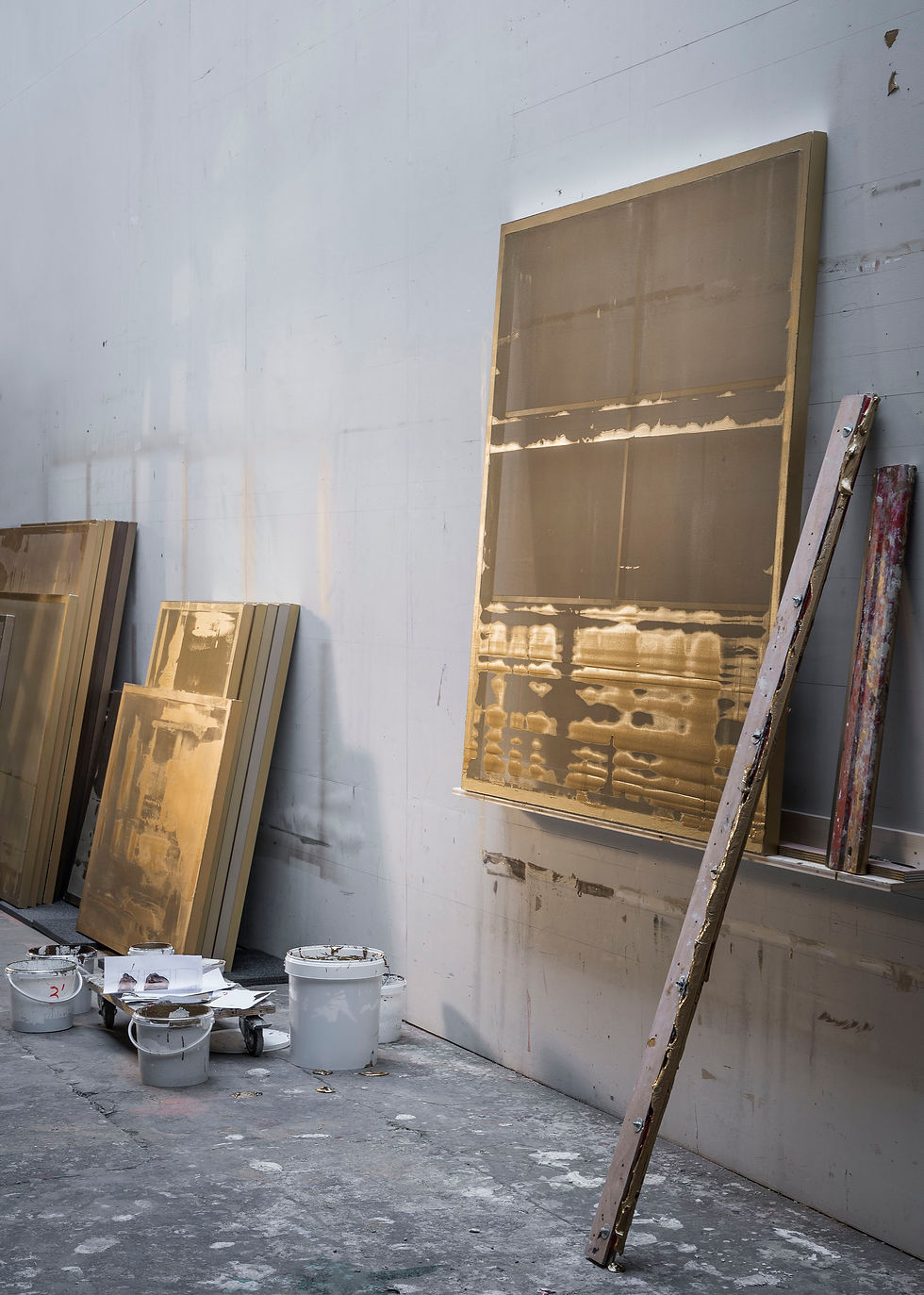
Inspired by nature and landscapes, the vibrant surfaces of Pierre Bonnefille’s works expand into space and create a unique and sensitive atmosphere. By working with natural pigments, mineral, limestone, lava or marble powders, one can recognise his signature in the textured materials and harmonious colours that define his wall creations as well as his furniture pieces.
At the beginning of the 1990s, with the help of Olivier Gagnère and Yves Taralon, he signed the large red fresco on the walls of Café Marly under the arcades of the Louvre. This first major public commission quickly led him to collaborate with other major names in interior design and architecture: Rena Dumas, Michel Boyer, Philippe Starck, Christian Liaigre, Bruno Moinard and many others.
Using material and colour as means of expression, Pierre Bonnefille initially focused on commissioned works, intervening in the context of private projects, hotels or restaurants, creating monumental wall pieces. He has collaborated with luxury houses such as Cartier, Hermès and Loro Piana.
The years 2015 and 2016 marked a turning point in Pierre Bonnefille’s work. His Bronze Paintings, inspired by reflections of light on water, resonated particularly strongly with the public. From a Carte Blanche at PAD London in 2016 (Galerie Leclaireur), to a solo exhibition at the Musée National des Arts Asiatiques – Guimet in 2021, and his participation in AD Intérieurs 2019 in Paris, Pierre Bonnefille has become omnipresent.

In 2010, he was appointed Maître d’Art by the French Minister of Culture, Frédéric Mitterrand. In 2020, the prestigious Academy of Architecture awarded him the Médaille des Métiers d’Art of the Paul Sédille Foundation, recognising his 35-year career as an “artist-researcher”.
“My first works revolved around earthy colours such as red or brown,” Bonnefille explains. “In my search for rare colours, I travelled the world: Italy, Belgium, and later to Africa and Asia. What interests me is the relationship between colour, material and light. Everything comes first from the earth, where there are countless natural treasures. I began by collecting and observing samples of local stone. The concept of transformation is at the heart of my work, hence the name ‘Metamorphosis’ for my furniture collection. Stones are ground into powder and, through this process, are given a new life in which the material is transformed and reinvented through successive layers, smoothing or polishing. I like to create new materials inspired by visual impressions, but also through touch, observation — and above all, through light!”
And eventually he discovered gold as the ideal material for his art.

“My installation at the Hôtel d’Heidelbach, created in collaboration with the Guimet National Museum of Asian Arts in Paris, was an ode to light. I used gold — but not for its market value or to make the work look expensive or ‘bling-bling’. Of course, gold can shine, but what interests me is its iridescent dimension, centred on light and expressive power. My series of Bronze Paintings is a play between bronze powder and gold leaf, aiming to capture this light.
But there are other monochromes too — works about reflections of water, ice, silver, moonrises. I love the texture that remains frozen on the canvas, as if it had been left to flow before being stopped, even though in reality it is highly controlled. I search for a sense of ephemerality shaped by my memory. A pleasant feeling of preciousness that generates incredible energy.”
Bonnefille works with pigments mixed with sand, stone or metal powders, binders and water-based solvents. “I can combine bronze powder or carbon with lacquer,” he says. “In some of my paintings I have used both moon gold leaf and bronze powder. Depending on the light source, the sensation is very different. The light of a bulb creates a silvery atmosphere, while candles produce a fire-like glow. It is my way of evoking abstract landscapes and thereby calling forth the primary vibrations of the universe.”
A curious element of his studio is his extensive collection of insects. “What fascinates me is the great complexity of their shells. Some absorb light while others reflect it, producing incredible brilliance and iridescence. I have around 100 small beetles. I am fascinated by their durability. Even beetle shells found in ancient Egyptian tombs have retained their colours.”
The artist also holds a particularly vivid memory of his first emotional encounter with gold. “I was only 22 when I entered this church in Ouro Preto, Brazil, entirely covered in gold and displaying all the baroque features of the period. The Portuguese settlers had built it. ‘Ouro Preto’ means ‘black gold’. The city was given this name because of its vast gold deposits, slightly darkened by iron oxide impurities. At the height of the gold rush, towards the end of the 18th century, Ouro Preto had around 100,000 inhabitants and was then the largest and wealthiest city in the New World. I stepped into this dimly lit church, and suddenly everything lit up — because of the gold. It was overwhelming.”


Meditation room is an installation created by Pierre Bonnefille that invites contemplation and meditation through an artistic lens. The camera obscura, the dark chamber, incorporates sculpture, architecture, painting and photography. Here, the installation becomes a painting in itself, unfolding across the space.
The entire structural surface invites visitors to stroll, linger and immerse themselves fully in the environment, which interacts physically with the viewer. Inspired by various elements observed in nature, the painting reflects different textures and colours and becomes a “space for thought”, where for a moment a particular image emerges — perhaps that of a celestial landscape.
The abstract series produced here reveals a special sense of imagery, along with a powerful materiality that appeals to all the senses.
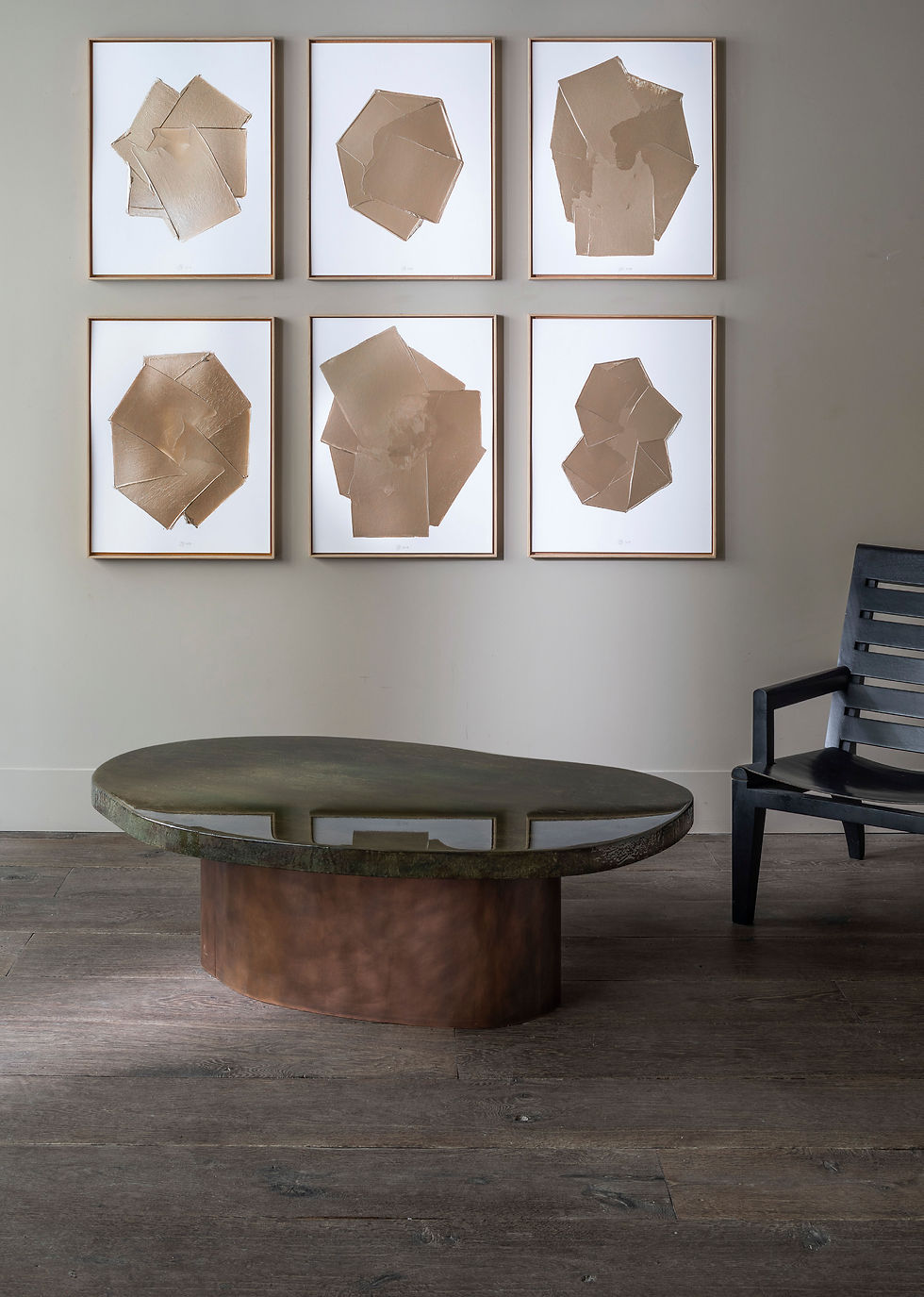
This series of works on paper is inspired by traditional Japanese painting. The art of Furoshiki is a prosaic and functional art form passed down from the Nara period (8th century), involving a set of folding and knotting techniques used for tying fabrics. Essential in medieval Japan, these techniques have since taken on an almost ritual character.
Pierre Bonnefille employs these techniques to apply a material of bronze or carbon onto paper.

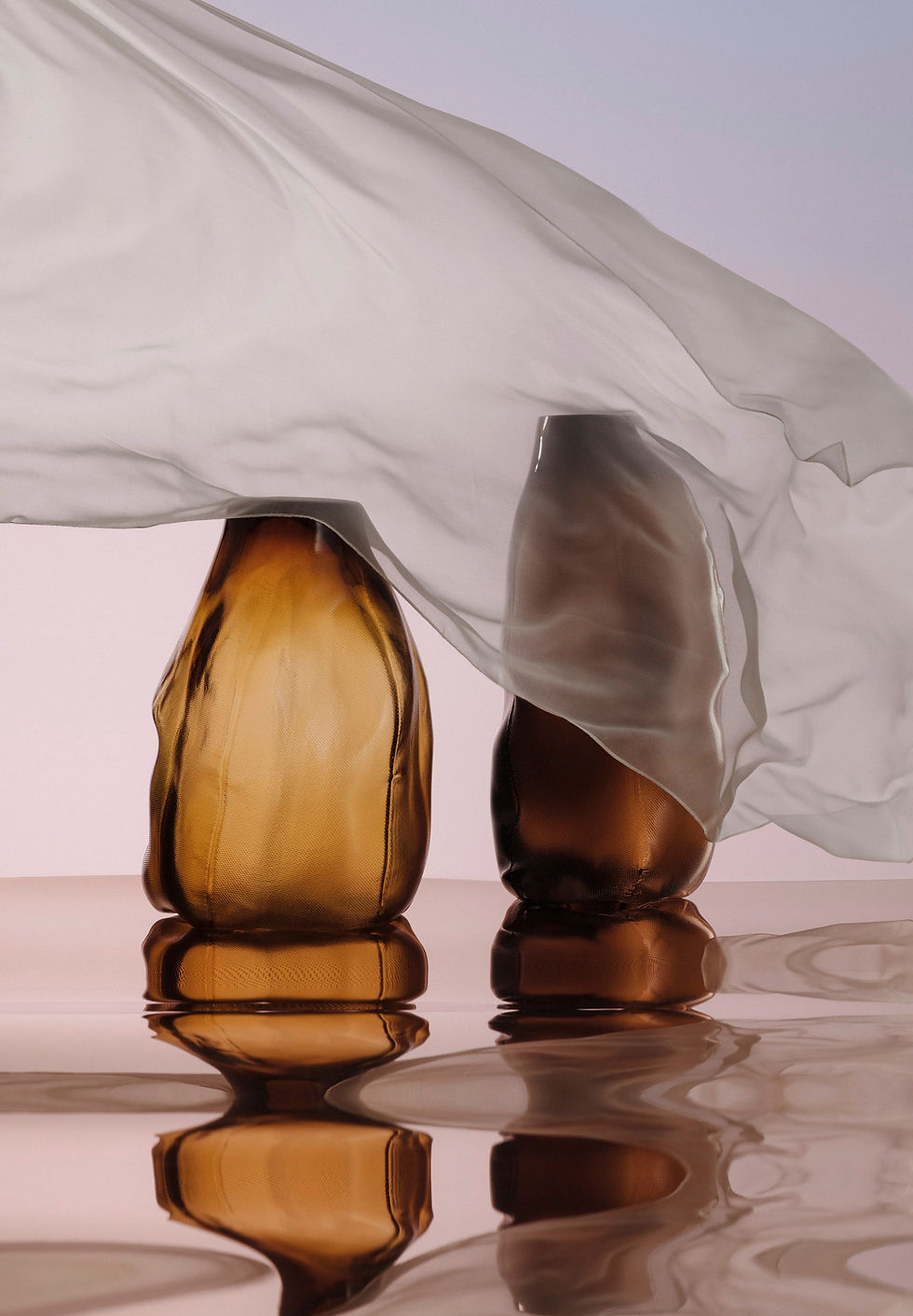
Rhizome emerged from Pierre Bonnefille’s fascination with Japanese Ikebana baskets. These flower baskets reflect the ancient traditional art of bamboo weaving, which reached the height of its perfection during the Meiji era in the 19th century. The bamboo is used in its entirety, from stem to root — woven, knotted, twisted — and thus transformed into a small plant-like masterpiece.
RHIZOME
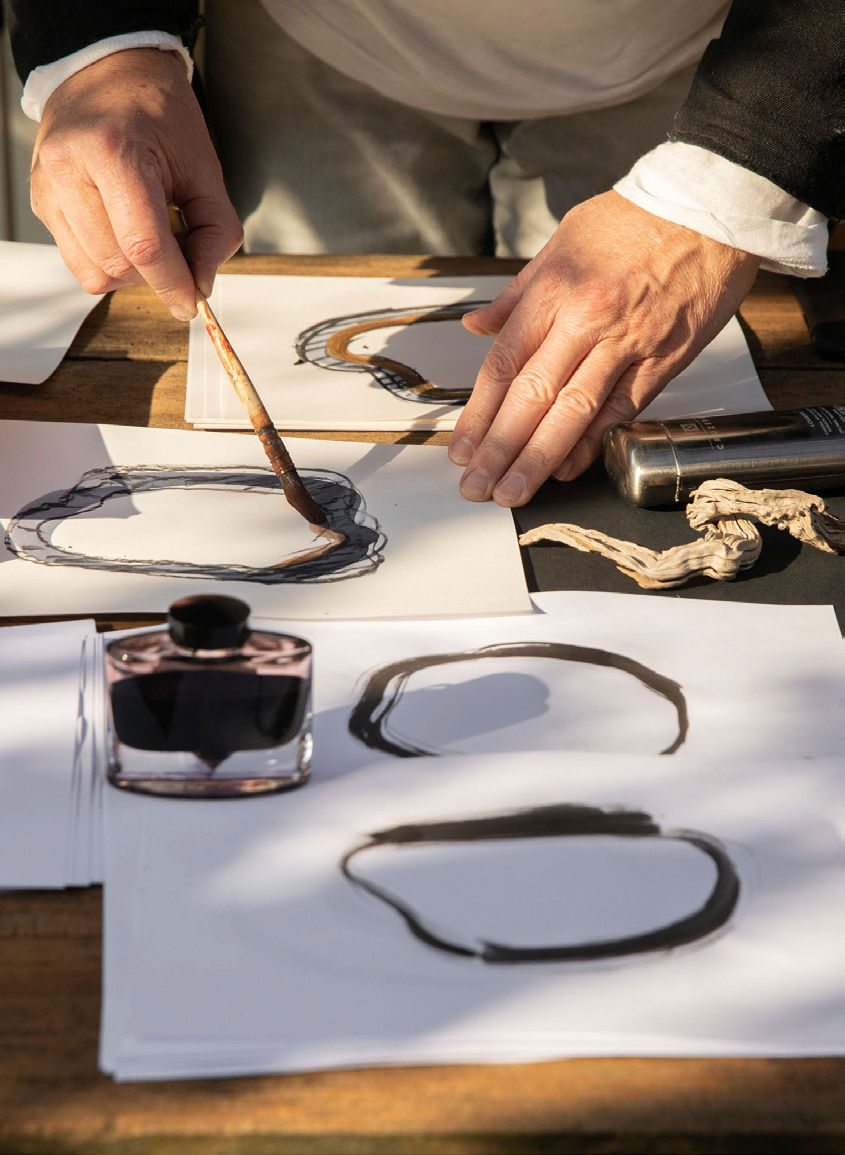
Creations from this series express the energy of plant life. First sketched with a brushstroke, the slender forms gradually unite into a single block, giving the objects in this series a particular inner tension. Pierre Bonnefille works the surface in successive layers using crushed charcoal powders, which ultimately tint the material.



Comments